
%20copy.png)
%20copy.png)
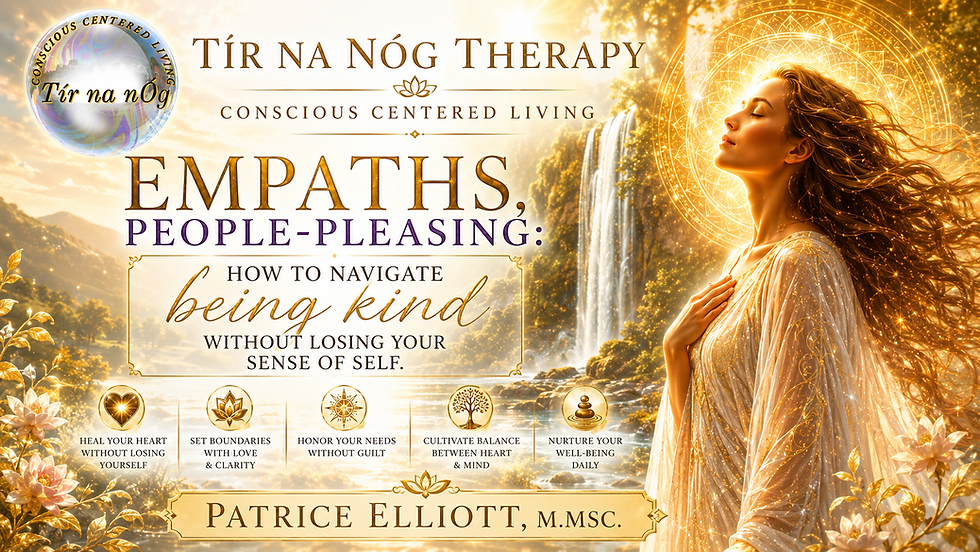
Empaths | People-Pleasing & How to navigate being kind without losing your sense of self.

In this video, I want to talk about how to navigate your kindness as an empath without losing your sense of self.
Empaths are often natural people-pleasers because they are wired to care, share, and show compassion.
They are often willing to put others first because loving and helping people is what makes them feel truly alive.
The challenge is that this can sometimes lead to weak boundaries.
And when boundaries are weak, people become more vulnerable to exploitation.
Kindness vs Self-Sacrifice
If you allow it, some people will use your kindness to build themselves up and then walk away when they no longer need you.
Fortunately, not everyone is like this. Many people are caring, respectful, and reciprocal. The challenge is learning to recognise the difference.
This is why boundaries are so important.
Many have been misguided into thinking the ego is the enemy, but a healthy ego serves an important purpose.
The ego helps us establish boundaries, recognise reciprocity, and understand when a relationship is balanced or one-sided.
The Ego expresses itself through the mind. It can be calculating and self-serving. A strong ego will make sure your best interests are being served. A weak ego will be overpowered by emotions.
The ego is interested in individuality.
The Soul expresses itself through the heart, which is loving, compassionate, self-sacrificing, and oneness orientated.
Both are important.
Without the heart, we become cold and disconnected.
Without a healthy, strong ego, we lack healthy boundaries and become at risk of feeling depleted, resentful.
A Jungian Perspective
Carl Jung believed that many people develop what he called a persona—a social mask we wear in order to gain acceptance, approval, or belonging.
For some empaths and people-pleasers, the persona becomes the "helper," the "good person," or the one who is always available for others.
Over time, this can create an imbalance. We become so identified with being kind, supportive, and accommodating that we neglect our own needs, feelings, and boundaries.
The danger is not kindness itself. The danger is losing yourself through fear of rejection or not being important or useful.
Jung believed that genuine growth comes from becoming aware of these unconscious patterns. As we become more conscious of why we say "yes" when we want to say "no," we gain greater freedom to choose our responses rather than acting from habit, fear, guilt, or the need for approval.
Healthy boundaries are not a rejection of love or compassion. They are part of becoming a whole and authentic person.
The goal is not to stop caring for others.
It is to care for others without abandoning yourself.
The real goal is balance.
I would like to offer Three Simple Practices to help you feel more balanced.
1. Never Act Out of Guilt
Do not do something simply because you feel guilty, pressured, or afraid of disappointing someone.
If your actions are not coming from a genuine place, pause and reconsider.
2. Be Honest About Your Limits
If you do not have something to give, say:
"I don't have it."
If you cannot do something, say:
"I can't do that."
You do not have to invent excuses or justify yourself.
Be careful about becoming harsh or cold.
If you feel you need to give a reason because it feels polite and caring, do that if it feels more in line with your character.
To justify yourself because you feel guilty can become disempowering.
Check your feelings and see what feels right for you as an individual.
It's important to take actions that promote growth, not actions that damage your sense of self or wellbeing.
3. Do Not Harm Yourself to Help Others
Do not harm yourself emotionally, financially, physically, or spiritually in order to help someone else.
Supporting others should not require you to abandon yourself.
This might take a long time to master, so don't feel as if you are weak. You are loving.
The Hidden Benefit of Boundaries
When you begin practising healthy boundaries, something interesting happens.
You stop resenting other people.
More importantly, you stop resenting yourself.
Another benefit of saying "no" when you are genuinely unable to help is that you begin to see who truly cares about you.
Some people may drift away when they realise your boundaries have changed. Others will respect your limits and remain in your life.
Healthy boundaries often reveal which relationships are built on mutual respect and which ones relied too heavily on your willingness to give.
Healthy relationships are built on mutual care, respect, and reciprocity—not guilt, obligation, or self-sacrifice.
Kindness is a strength however, kindness without boundaries can become self-abandonment.
You can learn to be compassionate without being a people-pleaser.
You can be loving without abandoning yourself.
Real kindness includes yourself too.
If you are looking for more in-depth guidance or support on your personal growth journey, you are welcome to book a free consultation. Simply get in touch via email or click the WhatsApp link at the top of the page.


Comments